When someone hears the name Skocjan caves they usually immediately picture a breathtaking underground world—a magnificent subterranean canyon carved over thousands of years by the unstoppable Reka River. Although this extraordinary natural phenomenon rightfully became part of the UNESCO World Heritage List, its significance extends far beyond the cave entrance itself. UNESCO Skocjan Caves Biosphere Reserve represents a much broader concept—a living embodiment of a philosophy in which people and nature not only coexist but thrive together in a mutually beneficial relationship. It is a place where the preservation of a unique landscape is inseparably linked to the preservation of human culture and tradition.
This area was in 2004 designated as a UNESCO's Man and the Biosphere (MAB) Programme, giving it the status of a Biosphere Reserve that redefines the meaning of nature conservation. Unlike a national park, where the emphasis is often on the strict protection of nature by limiting human activities, a Biosphere Reserve is a place for learning about sustainable development. It recognizes that local communities, with knowledge passed down from generation to generation, are not a threat to the environment but its most important stewards. The Karst Biosphere Reserve is therefore not a museum exhibit enclosed behind glass, but a dynamic, living landscape where sustainable agriculture, responsible tourism, and ecological research come together.
The Three Zones of the Biosphere Reserve
To achieve this delicate balance, the Biosphere Reserve is divided into three interconnected zones, each with its own distinct role:
Core Area: This is the most strictly protected zone, encompassing the Škocjan Caves and their immediate surroundings. Its primary purpose is to preserve geological formations, sensitive ecosystems, and unique plant and animal species. Human activities are kept to an absolute minimum and are limited mainly to scientific research and environmental monitoring.
Buffer Zone: This zone surrounds the Core Area and serves as its protective buffer. Activities carried out here are managed in a way that is consistent with nature conservation objectives. These include organic and sustainable farming, sustainable forest management, and educational tourism, all of which contribute to maintaining the health of the core ecosystem.
Transition Area: This is the largest and outermost zone, where the interaction between people and the natural environment is at its closest. It is the center of the region’s social and economic life, promoting sustainable agricultural practices, local entrepreneurship, and community initiatives that benefit both residents and nature. It is within this vibrant landscape that farms play an important role - such as JJ-LIPIZZANS.
Why Is the Karst a World Natural Phenomenon?
The term " karst ", which is now used worldwide to describe landscapes formed by the dissolution of soluble rocks such as limestone, originates from this very region—the Slovenian Karst. It is the "Classical Karst", the original region that has served as the foundation of speleological research for centuries and gave its name to the entire science of karst.
Its significance lies in its exceptionally well-developed karst features, both on the surface and underground. Vast subterranean canyons, an extensive network of caves, and the unique biodiversity they harbor are unparalleled. This landscape is the direct result of the interaction between permeable limestone bedrock and the regional climate, which together create a world where water is both the greatest force shaping the landscape and the source of life. It disappears underground, only to re-emerge at the surface, shaping every aspect of this unique natural environment.
Natural Attractions and Biodiversity of the Classical Karst
Appeal of the UNESCO Skocjan Caves Biosphere Reserve tells a story on two levels: of the dramatic, hidden world beneath the surface and of the delicate yet remarkably resilient life that thrives above it. After flowing on the surface for more than fifty kilometers, the Reka River disappears into the limestone underground at the entrance to the Velika Dolina (Great Collapse Doline), where its underground journey begins. Along this route, it has carved one of the largest known underground canyons in the world—a magnificent testament to the untamed power of nature and its patient creative force.
However, the magic of the Karst is not limited to the underground. The surface is a mosaic of distinctive karst features: sinkholes, karren, and dry valleys tell the story of water's hidden pathways. This seemingly rugged and rocky landscape conceals a remarkably rich biodiversity. Its flora is a unique blend of Central European and Sub-Mediterranean species, including many endemic plants that are perfectly adapted to shallow soils and dry conditions. Equally remarkable is its fauna—from the famous olm (Proteus anguinus), that inhabits the underground waters, to rare species of bats that have found refuge within the endless labyrinth of karst caves.
The Underground World: More Than Just a Tourist Trail
Although the guided tour of the Skocjan caves offers a breathtaking glimpse into this underground world, the true scale and significance of the cave system are far greater. Chambers such as the Martel's Chamber, with their extraordinary volume, inspire visitors with a sense of awe, humility, and respect for the geological processes that have unfolded over millions of years.
However, the caves are not only a geological wonder but also a valuable archive of human history. Archaeological discoveries within the cave system show that people sought shelter there as early as prehistoric times, leaving behind traces that help us better understand our past.
Today, a visit to the Škocjan Caves offers the opportunity to experience one of the world's most significant natural attractions, managed with the utmost care for both visitor safety and the protection of its natural heritage. This approach ensures that its outstanding values are preserved and remain accessible for future generations.
Life on the Karst grassland
Perhaps the most overlooked part of the Karst landscape is the grassland —traditional communal grazing land characterized by dry karst grasslands. These seemingly barren areas are, in fact, true biodiversity hotspots. The open landscape, maintained for centuries through the grazing of livestock, prevents forest overgrowth and provides ideal conditions for numerous plant and insect species that depend on sunny, open habitats.
This is a perfect example of the coexistence of humans and nature, where the traditional human activity of pastoral farming is actually the key factor in preserving exceptional natural biodiversity. The extensive pastures beneath Mount Slavnik are an excellent example of such a balance, where herds of domestic animals, including the noble Lipizzaners, share the landscape with wild animal species, together creating a balanced and resilient ecosystem.
The role of grazing animals is not merely part of the cultural heritage; it is essential for preserving the Karst landscape. Learn more about the benefits the tradition of free grazing for horses on the Karst and about how this farming method directly contributes to achieving the objectives of the Biosphere Reserve, you can read more below.
Man and the Biosphere (MAB): How Tradition Preserves the Future
A common misconception about UNESCO protection is that it "freezes a landscape in time" and places it beyond the reach of the people who have shaped it over the centuries. UNESCO's Man and the Biosphere (MAB) Programme The MAB Programme turns this perception on its head. Its fundamental principle is that humans are an inseparable part of the ecosystem and that a sustainable way of life is not only possible but essential for a healthy and prosperous future. The programme actively promotes the involvement of local communities and recognizes their traditional knowledge as an invaluable resource for preserving both natural and cultural heritage.
At the Karst Biosphere Reserve this means that farming is not prohibited but rather encouraged and guided toward sustainable practices. The MAB Programme supports the continuation of traditional crafts, the cultivation of local plant varieties, and the conservation of indigenous breeds of domestic animals. Local communities are recognized as the most important custodians of their heritage, as their everyday activities make a significant contribution to preserving the cultural landscape.
A particularly important aspect of this approach is the sustainable management of water resources in the region, which is known for its scarcity of surface water. This very challenge has, over the centuries, fostered human ingenuity and led to the development of numerous innovative solutions for living and managing the Karst landscape.
The Philosophy of the Man and the Biosphere (MAB) Programme in the Karst
The Philosophy of the Programme MAB on Karst is based on the active and thoughtful pursuit of balance. Its essence lies in achieving harmony between economic needs and responsibility toward nature. It is not about the passive preservation of the landscape, but about the active partnership between people and the environment.
The Biosphere Reserve serves as a model region, or "a living laboratory", where new approaches to sustainable development are developed, tested, and showcased. An important part of this includes educational programmes for schools and collaboration with research institutions, ensuring that the experiences and knowledge gained in the Karst can serve as inspiration and a model for other Biosphere Reserves around the world.
This is a vision in which the farmer’s field, the beekeeper’s hive, and the horse breeder’s pasture are just as important a part of UNESCO’s mission as the protected Skocjan Caves themselves.
The "Tu sem doma" ("I Feel Home") Brand: A Guarantee of Quality
To make the philosophy of the Biosphere Reserve as tangible as possible for both local residents and visitors, Skocjan caves developed the »Tu sem doma« ("I Feel Home") brand. This certification is awarded to local producers and service providers who meet strict standards of quality, authenticity, and sustainable practices.
Obtaining this brand represents much more than simply the geographical origin of a product or service. It signifies a commitment to ecological principles, ethical business practices, and the preservation of the Karst identity. When you see this label on a product or service »Tu sem doma« ("I Feel Home") brand - whether it is honey, cheese, a ceramic product, or a tourism service — you can be confident that you are supporting a provider who actively contributes to the preservation of the Biosphere Reserve.
This label enables consumers to easily identify and choose authentic Karst products and services while, through their purchase, supporting the local economy and contributing to the long-term success of the UNESCO's Man and the Biosphere (MAB) Programme.
A Practical Guide to Sustainable Visits and Local Experiences
Experience the UNESCO Skocjan Caves Biosphere Reserve It means much more than simply visiting the caves. It is an invitation to immerse yourself in the unique Karst landscape and its rich cultural heritage, experiencing it in a respectful and sustainable way that supports the local community. A sustainable visit is one that leaves a positive impact—both on the visitor and on the place they visit.
If you plan your visit outside the main summer tourist season, you will enjoy a more peaceful atmosphere while also reducing the impact on the natural environment. In spring, the Karst comes alive with colourful blossoms, while in autumn the landscape is cloaked in warm autumn hues.
The region is a true paradise for outdoor enthusiasts, offering an extensive network of well-marked hiking and cycling trails that lead through forests, across the Karst heathlands, and past traditional stone villages. Exploring on foot or by bicycle is the best way to discover the subtle beauty of the Karst while also helping to reduce your carbon footprint.
A culinary experience is also an essential part of any visit. Local inns and restaurants prepare dishes based on traditional recipes using locally sourced ingredients—from Karst prosciutto and honey to organic cheeses and aromatic wild herbs.
Where to Find the Best Local Producers and Service Providers?
The certificate »Tu sem doma« ("I Feel Home") brand It is the best guide to authentic Karst experiences. When choosing where to eat, what to buy, or which activities to try, look for this label. In doing so, you directly support the local economy:
- Visit Certified Farms: Many local producers welcome visitors, introduce them to their work, and offer the opportunity to purchase products directly from the producer.
- Shop at the Skocjan Caves Park Information Centre: The Visitor Centre in Matavun often offers a selection of certified local products, making it an excellent place to purchase authentic Karst souvenirs.
- Take Part in Local Events and Workshops: Throughout the year, various festivals and workshops dedicated to the Karst cultural heritage are held—from stone masonry to herbalism—offering visitors a more authentic connection with the life and traditions of the Karst.
Responsible Behaviour in Nature
As a visitor, you are a temporary guest in a sensitive and carefully protected natural environment. Your actions can have a lasting impact. By following a few simple recommendations, you will help preserve the beauty and unspoiled character of the Biosphere Reserve:
- Stay on Marked Trails: By staying on marked trails, you help protect sensitive vegetation and prevent soil erosion.
- Respect the Peace and Quiet: The natural sounds of the landscape are an essential part of the experience. Avoid loud or disruptive behavior, as it can disturb wildlife and other visitors.
- Leave No Trace: Take everything you bring with you back with you. Do not pick plants or disturb wildlife.
- Reduce Your Carbon Footprint: If possible, travel by train to nearby Divača or Hrpelje-Kozina, and explore the area on foot or by bicycle.
- Support the Local Economy: By choosing local family-run businesses, you directly contribute to the preservation of the Biosphere Reserve by helping local residents continue to live and work in a sustainable way.
JJ-LIPIZZANS: Proud Holders of the UNESCO Skocjan Caves Biosphere Reserve Certificate
In the Heart of the Transition Area of the Biosphere Reserve, in village Prešnica below Mount Slavnik, there is a family farm JJ-LIPIZZANS. It is not only a breeding centre for Lipizzan horses, but also a living example of putting the principles of UNESCO's Man and the Biosphere (MAB) Programme, into practice. Our long-standing commitment to tradition, sustainable management, and the preservation of the Lipizzan breed was officially recognized in November 2025 with the prestigious certificate »Tu sem doma« ("I Feel Home") brand, which is awarded by UNESCO Skocjan Caves Biosphere Reserve. This recognition is not merely an honorary distinction, but a confirmation of our important role in preserving the cultural and natural heritage of the Karst.
The Story of our farm JJ-LIPIZZANS is rooted in a close connection with the Karst landscape. Our approach to breeding Lipizzaner horses is unique and inseparable from the natural environment. The horses are not confined to stables but live on more than 100 hectares of expansive pastures, where they are free to roam. This way of breeding is important not only for the horses' physical fitness and well-being, but also serves an exceptionally important ecological role.
Through grazing, the Lipizzaner horses help preserve the biodiversity of the Karst grasslands, prevent overgrowth of the landscape, and help maintain habitats for numerous plant and animal species. A visit to the Karst, complemented by learning about the work carried out by JJ-LIPIZZANS, goes beyond a typical sightseeing experience and offers visitors a deeper understanding of a living heritage, where nature, tradition, and a sustainable way of life are woven together into a harmonious whole.
Lipizzaner Horses and the Karst Landscape: An Inseparable Connection
The connection between Lipizzaner and Karst dates back several centuries. This landscape is the cradle of the breed—the environment that shaped its renowned strength, intelligence, and endurance. At the farm JJ-LIPIZZANS we honor this heritage and build upon it through our commitment to sustainable farming and a natural approach to horse breeding.
More than 100 hectares of pastures provide the Lipizzaner horses with diverse natural grazing and ample space to roam freely, supporting their healthy physical development and well-balanced temperament. This approach Breeding Lipizzans as an Indigenous Breed respects their natural needs and instincts while helping preserve the authentic characteristics of the breed.
The farm's sustainable certification provides further assurance of our responsible approach to nature. It reflects our commitment to managing the land in a way that preserves soil fertility, maintains the natural balance, and enriches the Karst landscape rather than depleting it.
Frequently Asked Questions
What is the UNESCO Skocjan Caves Biosphere Reserve?
It is an area designated under the UNESCO's Man and the Biosphere (MAB) Programme recognized by UNESCO. It covers the area of Skocjan caves, which are inscribed on the UNESCO World Heritage List, as well as the surrounding Karst landscape. Its primary goal is to balance the conservation of nature and biodiversity with sustainable economic and social development, with local communities playing a vital role as active partners in preserving the region's natural and cultural heritage.
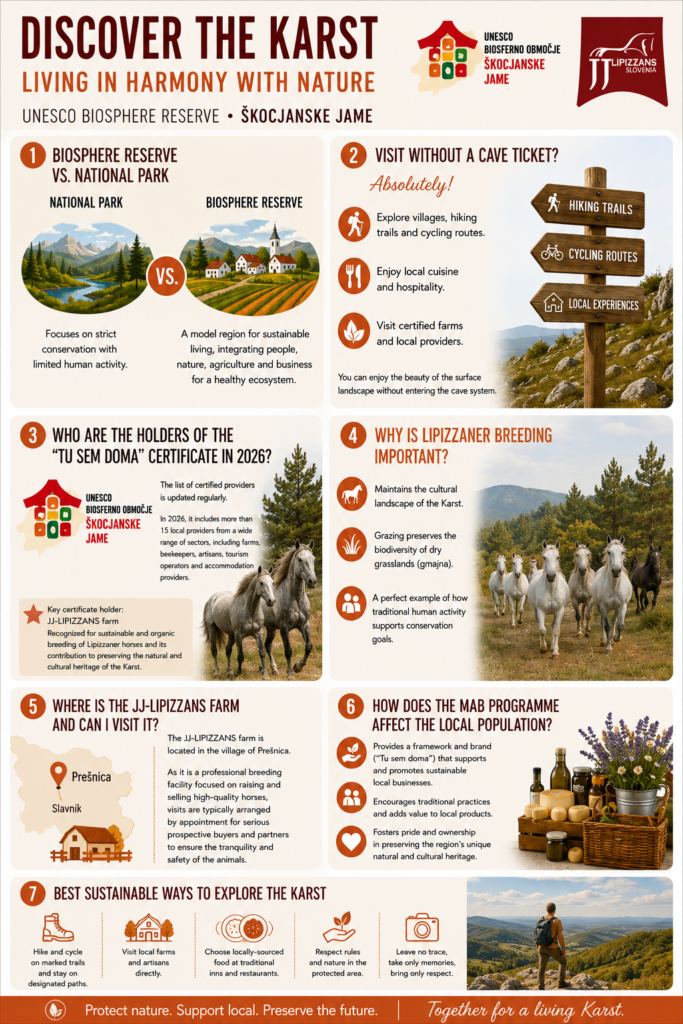
How is a Biosphere Reserve different from a National Park?
Although both are intended to protect nature, their roles are different. National park is generally focused on strictly protecting the natural environment, so human activities within its boundaries are often restricted.
A Biosphere Reserve , on the other hand, is designed as a model area for sustainable development, where nature conservation is integrated with the everyday lives of local people. Local communities, agriculture, entrepreneurship, and other sustainable activities are not seen as a threat to nature, but as an essential part of a healthy, balanced ecosystem and its long-term preservation.
Can I visit the Biosphere Reserve without a ticket to the Skocjan Caves?
Absolutely. The Biosphere Reserve covers a vast area of the Karst, including numerous villages, hiking trails, cycling routes, and local producers. You are free to explore the Karst landscape, enjoy the local cuisine, and visit certified farms and other local businesses, even without entering the Skocjan Caves cave system.
Who are the holders of the “ Tu sem doma " (I feel home) certificate in 2026?
The list of certified providers is updated regularly. In year 2026 includes more than 15 local providers from a variety of sectors—from farms and beekeepers to artisans, tourism providers, and accommodation providers. Among the certificate holders is also JJ-LIPIZZANS, which received the certification in recognition of its sustainable horse breeding practices and its contribution to preserving the natural and cultural heritage of the Karst.
Why Is Lipizzaner Horse Breeding Important to the UNESCO Biosphere Reserve?
Traditional free-range breeding of Lipizzaner horses plays an important role in preserving the Karst cultural landscape. Through grazing, the horses maintain the Karst dry meadows or grasslands, which are among the most important habitats for numerous plant and animal species in the region. This traditional approach to horse breeding is an excellent example of how human activity can directly contribute to nature conservation, the preservation of biodiversity, and the achievement of the goals of the UNESCO Skocjan Caves Biosphere Reserve.
Where Is the JJ-LIPIZZANS Farm Located, and Can It Be Visited?
Breeding farm JJ-LIPIZZANS is located in village Prešnica at the foot of Mount Slavnik. As it is a professional breeding farm specializing in the breeding and sale of high-quality Lipizzaner horses, visits are generally possible by prior appointment. This arrangement ensures the horses' peace, well-being, and safety, while allowing for a personalized approach to serious prospective buyers and business partners.
How Does the Man and the Biosphere (MAB) Programme Benefit Local Communities?
Programme UNESCO's Man and the Biosphere (MAB) Programme has a positive impact on local communities by providing a framework for sustainable development and, through its certification, »Tu sem doma« ("I Feel Home") brand supports and promotes local producers committed to sustainable practices. The programme fosters the preservation of traditional knowledge and skills, enhances the visibility and value of local products and services, and empowers local communities to take pride in and actively preserve the region's unique natural and cultural heritage.
What Are the Most Sustainable Ways to Explore the Karst?
The most sustainable ways to explore the Karst are those that have the least impact on the environment. These include hiking and cycling along the extensive network of marked trails, visiting local farms and artisans, choosing meals made with locally sourced ingredients at traditional inns and restaurants, and respecting the rules of conduct in protected areas. By exploring the region in this way, you contribute to the conservation of nature, support the local economy, and help preserve the Karst's cultural heritage.
We Invite You to Discover the World of Lipizzaner HERE.